Home › Services
Pool removal in Edina, from the first drained gallon to new sod
A backyard pool in Minnesota earns its keep for a short summer and plenty of owners eventually decide the upkeep, the heating and the cracked deck are no longer worth it. Taking one out is a small civil project: water comes out, the shell is broken or hauled away, the hole is filled in layers and compacted, and the surface is shaped so rain runs away from the house. Below you will find the pool types, the partial-versus-full decision, the pipes and wiring involved, and what that ground can hold afterward. Send the address and a few photos through the contact page to get a contractor out to look.
Why west metro owners take pools out
The reasons tend to stack up. A gunite pool built decades ago needs replastering, the coping is loose, the heater has quit and the pump room smells like a swamp every spring. A vinyl liner has faded and torn at the steps. The kids have grown up, yet the cover still goes on every fall.
Other owners are thinking about a sale. A pool narrows the pool of buyers in a climate where it is open for perhaps a third of the year, and some families with small children rule out a house with one entirely. Others simply want the space back for a garden or an addition.
The pool types you will find in Edina backyards
What the pool is made of drives almost every decision that follows, from how it breaks to where the pieces end up.
- Concrete pools, sprayed gunite or shotcrete with steel reinforcing, are the heaviest to remove and the most common in older neighborhoods. Breaking them takes a hydraulic hammer.
- Fiberglass pools arrive as a single molded shell. Once empty and cut into sections they come out relatively cleanly, though a shell left in the ground can float or shift if groundwater pushes up under it.
- Vinyl liner pools have walls of steel, aluminum or polymer panels standing on a sand or grout floor. The liner, the wall panels and the bracing all come out, and the metal usually goes to a scrap yard.
- Above-ground pools sit on the lawn on a sand pad or a ring of blocks. Removal is mostly disassembly and hauling, followed by repairing the dead rectangle or circle of turf they leave behind.
Partial removal: breaking out the top and filling the basin
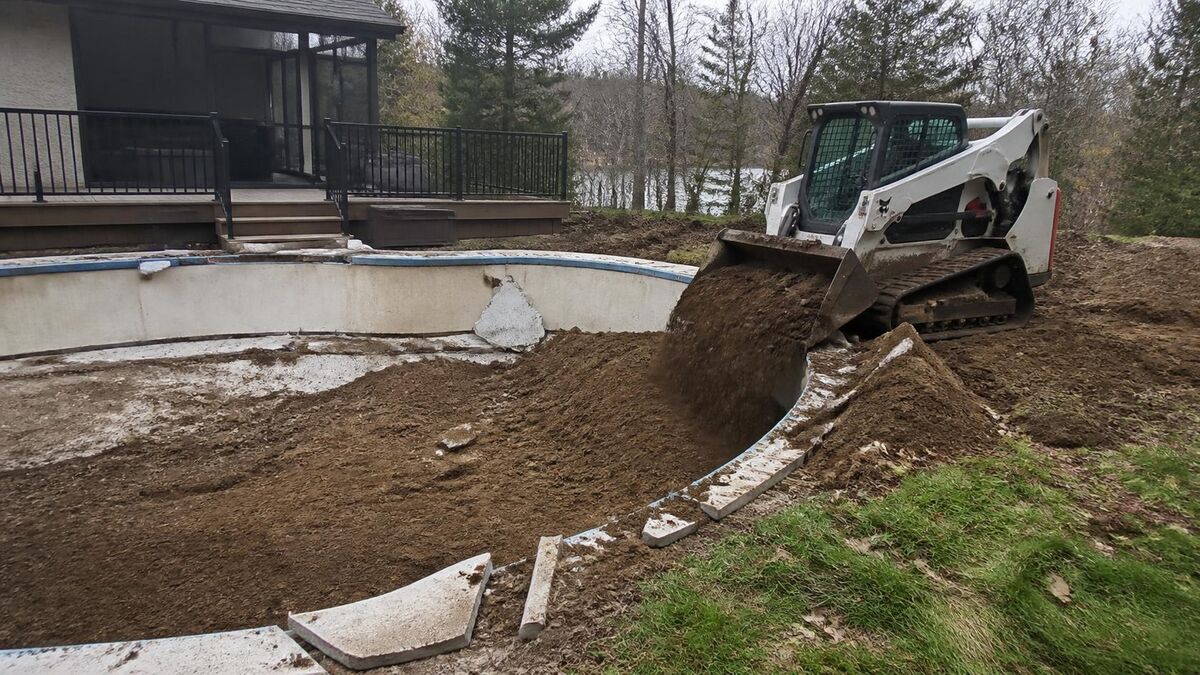
Partial removal, sometimes called an abandonment or a fill-in, leaves most of the shell where it is. The contractor drains the pool, breaks out the upper portion of the walls along with the coping and bond beam, and punches or cuts holes through the floor so water can pass down into the soil instead of pooling in a buried bowl. The broken concrete from the top is often dropped into the deep end, and then the hole is filled and compacted.
Less material leaves and less fill arrives, so it is usually quicker and cheaper. The tradeoff is that a structure remains underground. Anyone who later digs there for a footing, a tree or a utility line will hit it, and the area is normally treated as unsuitable for building on without further work.
Full removal: hauling out the shell and backfilling with engineered fill
Full removal takes everything out: walls, floor, steps, steel and the bedding underneath. What is left is an open excavation that gets backfilled with engineered fill, meaning a soil or aggregate chosen for how well it compacts, placed in layers and compacted as each layer goes in.
This approach is more involved and generates more truck traffic, but it removes the questions a buried shell raises. When a future buyer, an appraiser or a home inspector asks what is under the lawn, the answer is simply fill. When you want to pour a foundation or a slab there someday, a geotechnical review of the backfill has something reasonable to evaluate.
How to choose between a fill-in and a full haul-out
Neither method is right for every yard. A few questions usually settle it.
- Do you ever plan to build on that spot? An addition, a garage, a sport court or a three-season porch all point toward full removal.
- Are you selling within a few years? Many buyers and their agents feel more comfortable with full removal and documentation, and a buried shell is something you may have to disclose.
- What does the city say? Some cities accept either method with an inspection, while others have preferences or conditions; the permit office is where that answer lives.
- How is the yard reached? A tight side yard between houses can make the extra truck trips of a full haul-out slower and harder, which pushes cost up.
- How wet is the site? Near the creeks and lakes, a shell that traps water can turn into a soggy, settling patch, and drainage holes alone may not solve that.
Step by step through a typical removal
A contractor adjusts this order to the yard and the weather, but it holds for most jobs.
- Walk the site, measure the pool, note the deck and equipment, and check how machines and trucks can reach the backyard.
- Pull the permit if the city requires one and call Gopher State One Call so buried lines are marked before any digging.
- Have an electrician disconnect and make safe the pool circuits, and cap the water supply and any gas line to a heater.
- Drain the water to a location the city allows, which is often the sanitary sewer rather than the street or a neighbor's yard.
- Remove the decking, coping, fencing and equipment pad, then break or cut the shell according to the chosen method.
- Haul out the debris, sorting concrete and metal from the rest.
- Place fill in layers and compact each one, testing or inspecting as the plan or the city requires.
- Spread topsoil, grade the surface to shed water away from the house, and seed or sod.
Draining the water without flooding the block
A residential pool holds a large volume of water that has been treated with chlorine or salt, and dumping it carelessly can kill lawns, overload a storm drain or send a sheet of water across a neighbor's driveway. Many cities in Hennepin County want pool water sent to the sanitary sewer through a cleanout, or allowed to sit uncovered until the chlorine dissipates before any of it reaches storm drains that run toward Minnehaha Creek, Nine Mile Creek or the lakes. The rules vary by city, so the contractor checks before the pump starts.
On a lot with a high water table, an empty shell can float upward when the surrounding soil is saturated, so contractors move quickly from draining to demolition.
Fill, layers and compaction: the part that decides how the yard settles
Most of the failures people see after a pool removal trace back to the fill. If loose soil is pushed into the hole all at once, it compresses unevenly over the next few seasons. The lawn dips, a puddle forms where the deep end used to be, and a patio or shed set on top tilts.
The fix is placing fill in thin layers and compacting each layer with a plate compactor, a jumping jack or a roller before the next one goes on. The right material matters too: sandy or granular fill drains and compacts predictably, while wet clay from a basement excavation somewhere else can be stubborn. The glacial till common around Edina varies from tight clay to sandy pockets, so the existing soil around the pool also influences what fill a contractor brings in.
Ask how compaction will be checked: a city inspection on a simple fill-in, or density testing by a soils engineer when a structure may follow.
Decking, fencing, equipment and the lines running to the pool
The pool itself is only part of the job. Concrete decking and coping usually come out with it, though a solid patio well away from the edge can sometimes stay. If you are reworking a larger area of flatwork at the same time, the concrete removal page covers driveways, patios and slabs on their own. Fencing, the pump, filter, heater and any automatic cover are disconnected and hauled.
Underground, there are skimmer and return lines, a main drain line, perhaps a gas line to the heater and electrical conduit from the house panel to the equipment. Each of these is cut back and capped, and the electrical circuits are made safe by an electrician rather than simply buried live. A pool house or a detached cabana is a separate structure; the garage and shed demolition page handles outbuildings like that.
Permits, records and telling the next buyer
Cities around the west metro generally treat pool removal as work that needs a permit, and some want to see the drained, broken shell or the open excavation before fill goes in. Rules differ between Edina, Minnetonka, Eden Prairie and Bloomington, so the starting point is the building department of the city where the house sits.
Keep the permit, inspection sign-off, job photos, fill tickets and any compaction results in one folder. When the house sells, that record turns a buried-shell question into a short conversation.
Using the old pool spot later, and the factors behind the price
Once the shell is hauled out and the backfill is compacted with records kept, that ground is generally fit for grass, planting beds, a patio, and even a building if an engineer reviews the soil first. After a partial removal, plan on lawn, planting beds, a light patio or a play set, and expect any future builder to treat the spot with caution.
Every contractor prices the job only after seeing the yard, but the same factors move the number up or down from one property to the next.
- Pool size, depth and shape, and whether it is concrete, fiberglass, vinyl or above-ground.
- Partial versus full removal and the amount of fill that has to be trucked in.
- Backyard access, including gates, slopes, retaining walls and whether a fence section must come down.
- The amount of decking and coping to remove and how much steel is in the concrete.
- Electrical, gas and plumbing work, permit requirements and any compaction testing.
- Debris handling, since broken concrete is often crushed and recycled, metal is scrapped and the rest goes to a landfill or transfer station.
Pool removal in Edina — common questions
Should I pull my old pool out entirely or just break it down and bury it?
It depends on what you want the yard to do later. Filling in, with the top broken out and the floor perforated, is quicker and usually costs less, and it works fine under lawn and garden beds. Removing the whole shell and backfilling with compacted engineered fill takes more trucks and more time, but leaves ground that behaves like ordinary soil. If you might build on the spot or sell soon, full removal tends to answer more questions. If the area will stay green for good, a fill-in is often reasonable.
Do I need a permit to remove a swimming pool in Edina?
Most cities in the Twin Cities west metro expect a permit for in-ground pool removal, and the building department may schedule an inspection before the hole is filled. Requirements differ from city to city and can change, so the safest step is to ask the city where the house sits, or let the contractor handle the application as part of the job. Above-ground pools are often simpler, but it is still worth a quick call to confirm.
How long does an in-ground pool removal take?
The digging and filling often fit within a short stretch of days on a straightforward yard, but the calendar around that work varies much more. Permit review, scheduling an electrician, waiting for utility locates, weather, and inspections all add time. Wet spring ground and frozen winter ground both slow things down in Minnesota, and spring road load limits can delay heavy fill deliveries. The contractor can give you a realistic sequence once the site has been seen.
Will the ground sink after a pool is filled in?
It can, if the fill was dumped in loose or the wrong material was used. Settlement shows up as a dip in the lawn, standing water after storms or a patio that slowly tilts. Placing fill in layers, compacting each one and choosing a soil that drains reasonably well keeps settling to a minimum. A little topsoil touch-up after the first winter is normal; a visible bowl is a sign the compaction was not done properly.
Can I build a garage or addition where my old pool was?
Often yes, but the method matters. Where the entire shell was hauled out and the backfill was compacted and tested, a structural or soils engineer can evaluate whether the ground will carry a foundation, and footings can be designed to suit. Where the pool was only partially removed, the buried concrete and less controlled fill make building directly on top much harder to approve. If a future structure is even a possibility, mention it before the removal method is chosen.
What happens to the concrete and metal from a demolished pool?
Broken concrete from the shell and deck is commonly taken to a recycler that crushes it into aggregate used under roads and slabs. Rebar, wall panels from vinyl pools, ladders, rails and pool equipment go to metal scrap. Liners, plastic plumbing, covers and mixed debris usually head to a landfill or transfer station. When only the top is broken out, a share of the rubble is left down in the old basin and becomes part of the backfill.
Should I tell buyers that a pool was removed from my yard?
Sellers are expected to share material facts they know about a property, and a former pool, especially one only partly removed, generally falls into that category. Being upfront rarely hurts a sale when you can hand over the permit, the inspection record, photos from the job and notes about the fill and compaction. Talk with your real estate agent or an attorney about exactly how to word the disclosure for your situation.
Talk through your site
Start with the address, what needs to come down, and a few photographs of the structure and the access to it.
Related work
House Demolition
Full teardown of a house down to a backfilled, graded lot, with the basement handled and utilities cut first.
Garage and Shed Demolition
Detached and alley garages, sheds, decks and gazebos taken down and hauled off without wrecking the yard.
Interior Demolition
Kitchen, bath and basement gut-outs down to the studs, protecting what stays and hauling what goes.
Concrete Removal
Frost-heaved driveways, patios, walks, steps and slabs broken up and removed, with the base left ready.
Across the metro
Minneapolis
The city itself: early twentieth-century houses, alleys, detached garages and tight city lots.
Minnetonka
Lake-country suburb with wooded lots, slopes, shoreland and older ramblers on big parcels.
Eden Prairie
Southwest suburb with 1970s-and-later subdivisions, walkout basements, decks and pools.
Bloomington
Large postwar suburb with ramblers, split-levels, aging slabs and lots near the river bluffs.